
Clients giving up on therapy for personal support and adjustment is a real and present circumstance within the profession.
From the client's point of view, a perceived poor fit or a bad experience can shape a negative view of therapy. It could be from one bad session or multiple attempts at treatment. Either way, they believe they've tried it and, for them, it just doesn't work.
Consider the following results of different meta-analyses of therapy studies:
21.9% of therapy clients revealed they had prematurely ended their treatment
17.5% of individuals receiving therapy for depression dropped out specifically among therapy conditions
16.99% of clients with generalized anxiety disorder dropped out of their therapy
20.6% of individuals in interpersonal therapy had dropped out across 72 randomized trials
Going by this data, we can speculate that depending on the therapy population, the treatment and the definition of dropping out, 15%–25% of therapy clients leave their treatment before it is completed.
Picture you're a therapist serving clients from Oswego, Aurora, Plainfield and Naperville (IL). It's Tuesday morning, and your schedule is full until day's end. Beginning right away, your first two clients are new ones.
The first client is an Oswego male in his early forties. He is a professional financial analyst. You welcome him into your office and he seats himself.
He is well groomed and aware of his presentation from his shoes to his haircut. His back is always nearly straight, even as he sits, and his gestures and eye movements are deliberate.
You open with warmth and a smile. He only observes you. Having reviewed his intake information, you understand he struggles with tightly concealed chronic stress and anxiety. He often copes by drinking alone at night and engaging in numerous shallow, non-committal romantic relationships. He feels he might be losing control of his escapes.
He reveals little beyond top-level symptoms. As you listen, he glances around your office with disapproval at the wall art and the furnishings. He doesn't pick up on your cues of ease and compassion. When you begin to discuss different therapeutic approaches, he says, "do you even know what you're doing?"
Your day's second client strolls into your office with a notable lack of self-awareness. She bumps into a chair, laughs at her clumsiness and then plops down into it.
She is a 26-year-old married Plainfield woman with two young children at home. Her husband, 36, is a plumber with his own company. She works part-time as a restaurant server.
You know from initial profiling that, despite her cheerful demeanor, her home life is difficult. Her husband works long, hard hours and vents his frustrations at night. He is emotionally avoidant and he often loses his temper, including in front of the kids.
When she starts to raise a boundary, her husband softens and sometimes love-bombs her as well. She's been dealing with the stress of the inconsistency by compulsion-shopping that is maxing out a credit card.
You quickly discover that you both like the same music and TV shows. She smiles a lot and she laughs with even slight passes at humor. She crosses her legs, slings her arm onto her chair back and says, "okay, let's do this."
From your initial impression, which of the two clients described seems like a good fit for therapy, and which is the most likely to remain in treatment?
For individuals from Oswego, Aurora, Plainfield and Naperville who may have felt therapy was their hope for peace, they might view one or more poor experiences as evidence that therapy isn't helpful.
One qualitative meta-analysis looked at themes indicating negative experiences in therapy from clients' perspectives. The analysis extracted from 51 primary studies to categorize meta-categories relating to what clients may dislike about their therapy.
The identified meta-categories are as follows. The percentages given convey the amount of studies among the 51 in which the meta-category emerged as a theme.
| Meta-Category Negative Experience | Study Appearance (%) |
| Process too structured or unstructured | 65% |
| Unpleasant feelings during therapy | 60% |
| Therapist devaluing the client | 56% |
| Dissatisfaction with how therapy concludes | 50% |
| Feeling fear of the therapy process | 50% |
| Perceived no change or insufficient change | 46% |
| Experiencing distance or a lack of empathy | 44% |
| Other inappropriate verbal reactions | 40% |
| Therapist not understanding | 37% |
| Therapist seen as incompetent | 37% |
| Increased problems after therapy | 37% |
| Negative cognitions aroused in therapy | 35% |
| Negative evaluation of therapy's practical aspects | 33% |
| Unmet expectations | 33% |
| Judgmental therapist | 33% |
| Therapist using client for their own benefit | 27% |
| Poor interpersonal match with the therapist | 25% |
| Loss of hope or motivation; being resigned | 23% |
| Experiencing confusion or uncertainty | 23% |
| Experiencing insecurity or distrust | 21% |
| Therapist not listening | 17% |
Clearly we see how many different variables can determine whether a client views therapy unfavorably. This makes an adaptive, attentive, self-aware therapist all the more important to supporting clients through their distinctive challenges.
A good match between a client and a therapist – also referred to as the therapeutic alliance – can often determine the client's perceived experience. The alliance less involves the therapist's skill and qualifications and more concerns the two-way connection established.
Some who've been in a therapy setting may be able to tell of when it just didn't feel right. Something about the vibe was off. For example, maybe the therapist presented as either too clinical or too casual. Perhaps the therapist's speech and body language didn't align. Sensitivity, compassion and attentive listening might have been absent in spite of what the therapist believed was being accomplished.
A conclusion supported by research, having a positive therapeutic alliance is a major predictor of success in therapy. Not all clients and therapists can work with each other. Some clients may prove to be resistant to therapy. Some therapists may have their own dissatisfactions or problems that carry into and detract from their practice.
From the client's perspective, a positive therapy experience will typically include several if not all of the following factors.
Feeling safe & comfortable. The client wants to feel respected and believe they can speak openly without judgment. There should be an atmosphere of safe exploration.
Shared understanding of goals. The client and therapist agree about what is the target for change, what progress looks like and which approach can best maintain it.
Communication style. Some clients like warm and affable therapists. Others would prefer one ready to directly challenge them. Some clients also are expressive while others may be more reticent. How prepared is the therapist to adjust?
Trust & credibility. Clients will often better respond to therapy when they feel the therapist is listening to and adapting with their concerns.
Compatible worldview. This can be relevant in today's polarized culture. If a client is passionately liberal and the therapist is staunchly conservative, for example, even unintended clashes of view can arise. Professional boundaries and respect need to be recognized and maintained.
Ability to challenge & pivot. A good therapist will not always be agreeable. When appropriate, he or she will properly challenge client perceptions and patterns and present alternatives while still validating the client's experience.
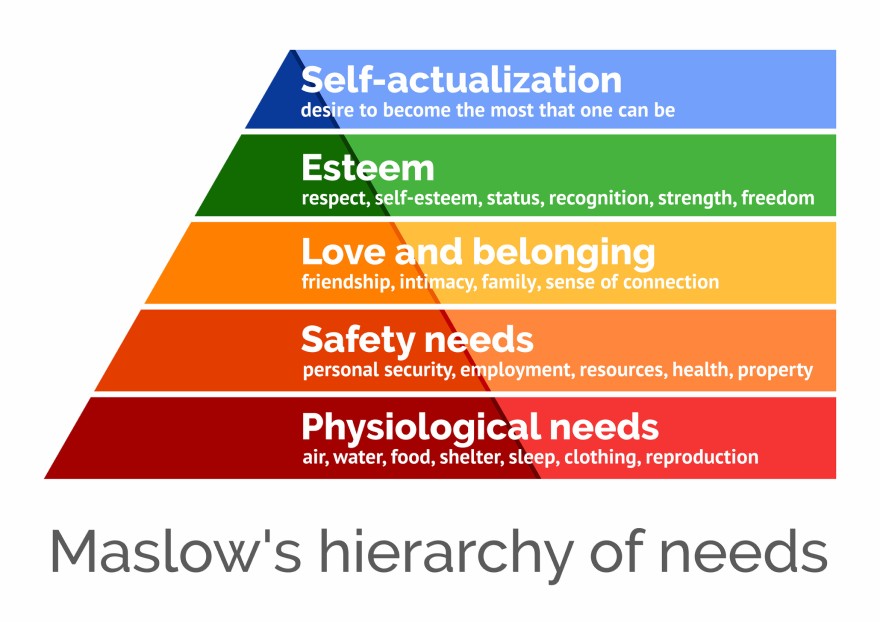
The factors for a good client-therapist relationship can draw parallels with Maslow's hierarchy of needs [see Figure 1]. Working from the bottom up, the establishment of each human need allows the individual to advance higher toward full self-actualization.
5 Physiological needs > 4 Safety > 3 Love & belonging
> 2 Esteem > 1 Self-actualization
In relating to the model, a therapy setting that makes the client feel physically and emotionally safe (levels 5 and 4) will help open the way to exploring a healthy perspective of the next level of human need (3 love and belonging).
Without meeting the first two requirements, clients will be less prepared to engage the parts of the brain required for progressive therapy work.
Now, returning to our clients described at the outset, which seems like a better fit for therapy, as well as more likely to stay with it?
The truth is that we don't know yet. Deep down, the insular financial analyst might be yearning for an opening to let down his fortified guard so he can engage healing with all of his will. Conversely, the affable female patient could later prove to be averse to practicing skills learned and discussed.
In time, with listening, patience and care, the therapist can potentially come to understand and respect how both clients are coping with struggle and grow with them in their self-discovery. Only time can tell if the fit will endure – it's the therapist's role to give it an earnest, balanced effort.
At Empowered Life Therapy, we emphasize not having one therapeutic style or approach. It depends on each individual client. As we sense the developing relationship, we may also often ask important questions such as whether the client would like that we challenge harmful behaviors or that we educate or simply listen to them.
It's incumbent on us to read cues such as body language and facial expressions as well. Sometimes a client will consent to something, such as a challenge, but we can sense an underlying defense or sensitivity.
Should a client determine a therapist is not an optimal fit, that view can be a natural part of the individual healing process. In that event, we will recommend another therapist. If needed, we can also refer a client to other local resources with whom we have wonderful working relationships. The client's healing and peace will always lead the way.
Empowered Life Therapy believes in living as the authentic self in emotional safety, strength and clarity. If you or someone you care about would like to discover more about our versatile approaches to therapy, we welcome your inquiry. Simply contact us at (630) 383-9999 to discuss our therapy for Oswego, Aurora, Plainfield and Naperville (IL).
[FIGURE 1]
 Kasey Huff
